

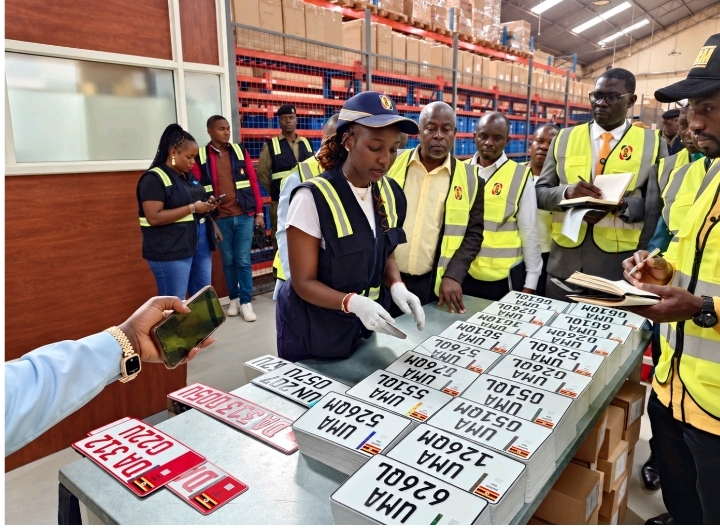
KAMPALA, Uganda: 02 October 2026— Members of Parliament’s Committee on Physical Infrastructure have confirmed that Uganda’s Digital Number Plate System is fully operational, after conducting an unannounced inspection and hands-on test at the Police Command Centre in Naguru. The visit, led by Committee Chairperson Hon. Mwine Mpaka, comes after weeks of intense legislative scrutiny regarding whether the multi-billion-shilling security and vehicle-tracking project was delivering on its promises.

Determined to move beyond official reports, committee members brought their own personal vehicle registration numbers to test the system live, demanding the police trace them in real time. The monitoring team successfully pinpointed the exact location coordinates of the vehicles, demonstrating the technology’s ability to track mobile assets across the country.
“Yes, indeed, we have established that cars and motorbikes can be tracked,” Mpaka said following the demonstration. “The issue of digital number plates is clearly important. We just need to see how we can improve the system.”

Inspector General of Police Abas Byakagaba, alongside Police ICT Director AIGP Felix Baryamwisaki, guided lawmakers through the command center’s operational workflow. Police data presented to the committee revealed that the system has already aided in the recovery of 337 out of 375 reported stolen vehicles—a 90% recovery rate.
“As far as I am concerned, the system is working, and it is giving us solutions in our investigation,” Byakagaba told MPs.
Lawmakers also addressed data privacy and sovereignty concerns during the visit. UPDF representative Gen. Samuel Okiding noted that the committee verified that all data generated by the tracking system is hosted and stored locally within Uganda.
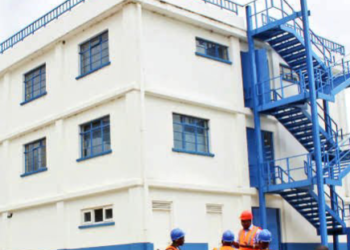
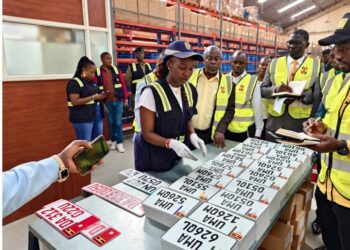
The command center visit followed a parallel inspection of the project’s central manufacturing facility, where MPs evaluated production capacity, fitment delays, and local content compliance.
The production plant currently operates at a capacity of 2,500 plate kits per day (50,000 monthly)—a rate sufficient to clear previous supply backlogs.
The facility employs over 300 Ugandans directly, supports 900 secondary jobs, and maintains an 80% localization rate, making it the first full-cycle number plate manufacturing plant in East Africa.
While the committee acknowledged significant operational progress, lawmakers emphasized that validation of the technology does not absolve the project of administrative scrutiny.
“One thing for sure is, the whole country needs the digital number plate system,” Mpaka added. “As a committee, we are now looking at the cost and the contractor’s capacity. Other than that, no one is against the project.”
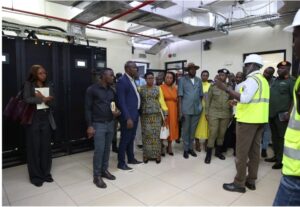
At the same time, inspections highlighted areas where implementation can be further strengthened. The focus is therefore increasingly shifting towards strengthening cooperation among participating institutions, improving Police operational and administrative procedures and ensuring clearer communication with motorists and other stakeholders.
With the security capabilities now verified, the committee’s focus shifts toward addressing remaining implementation bottlenecks, including reducing fitment fees, streamlining inter-agency coordination, and improving public communication with motorists.