
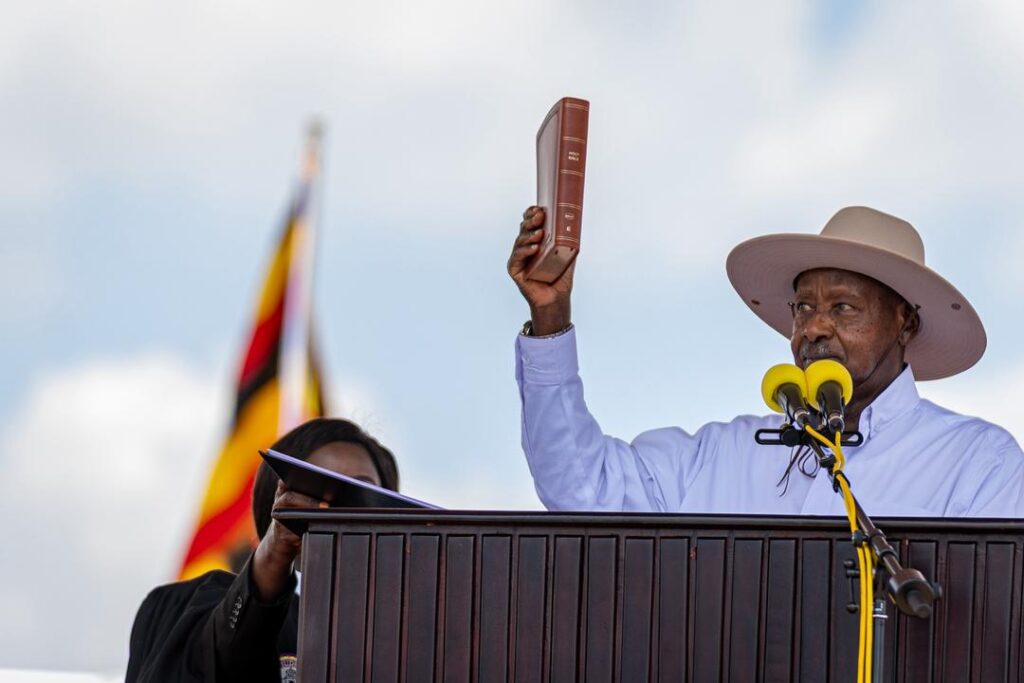
KAMPALA, Uganda 12 MAY 2026 — President Yoweri Kaguta Museveni was officially sworn in for a new term at the Kololo Ceremonial Grounds on May 12, 2026, marking the occasion with a stern call for a national “wake up” to wealth and job creation. Addressing a gathered crowd of citizens and international dignitaries, the President declared this term the “Kisanja of no more sleep,” emphasizing a shift from subsistence living to full participation in a modern money economy.
A Mandate for Economic Transformation
The President opened his address by congratulating the National Resistance Movement (NRM) on its success in the series of elections beginning in January 2026. He framed the new mandate as a transition from building “matafaari” (contributions) like peace and infrastructure to focusing on the personal wealth of individuals and families.
Central to his vision is the four-sector model of the economy;
Commercial Agriculture: Museveni highlighted the “four-acre model” and small-scale success stories, such as farmer Nyakaana, who reportedly earns Shs 240 million annually from 1.3 acres.
Manufacturing: The President stressed the need for value addition, calling the export of unprocessed raw materials like gold and coffee a “strategic blunder” that “donates” money and jobs to foreign countries.
Services and ICT: Expanding the hospitality and tourism sectors, and Leveraging the knowledge economy to create high-skilled positions in fields like automobile manufacturing and pharmaceuticals.
Addressing the issue of youth unemployment, Museveni argued that if Ugandans adopted his recommended economic models, the country would face a labor shortage rather than a surplus. He claimed that full participation in the four sectors could create over 100 million low-skilled jobs in small-scale agriculture alone.
Furthermore, he called for a “retuning” of the national educational system to concentrate on imparting skills that align with actual labor market needs, moving away from “random education”.
A significant portion of the speech was dedicated to environmental protection as a prerequisite for sustainable agriculture. The President issued a firm directive: all rice and potato growing in wetlands must stop.
”We need our wetlands for both our rain and irrigation,” Museveni stated. He proposed replacing swamp-based crops with fish farming at the edges of wetlands, which he described as more profitable and environmentally sound. To support this, the government plans to provide earth-moving equipment for fish ponds and solar-powered water pumps.
Reiterating his long-standing support for the East African Federation, Museveni argued that political and economic integration is essential for both expanded markets and “strategic security”. He noted that a unified region would better enable defense across land, air, sea, and space.
The President concluded by inviting all citizens to participate directly in government programs like the Parish Development Model (PDM) and Emyooga, urging them to hold leaders accountable for the management of these funds at the local level.